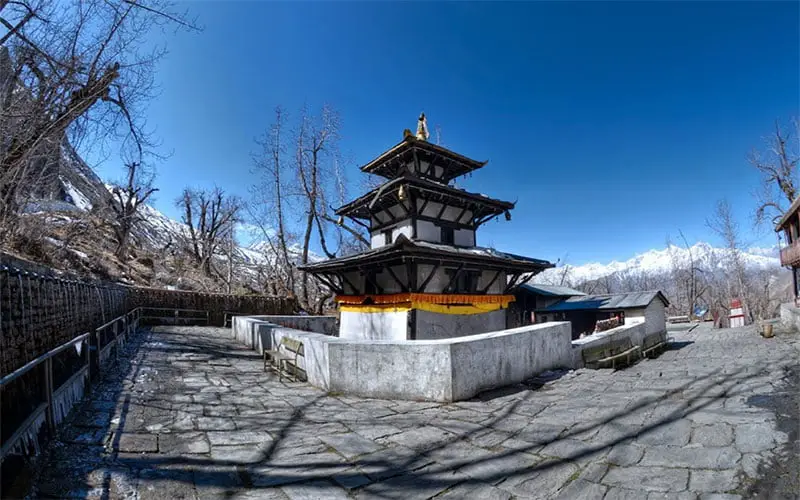
Muktinath Dham Hindus ke sabse mahatvapurn mandirom mein se ek hai. Yah Nepal ke Mustang zile mein Thorang La pahadiyon mein 3,750 meter, lagbhag 12,300 feet ki oonchai par sthit hai. Yah mandir Pagoda style mein bana hua hai. Muktinath kshetra paanch tatvon se paripurn hai. Yah samast papo ka nash karne vala tirth mana jata hai. Aisa mana jata hai ki Bhagwan Vishnu ko Rakshas Jalandhar ki patni Vrinda ke shrap se bhi yahin mukti mili thi. Kathaon ke anusar Muktikshetra vah sthan hai jahan moksh ki prapti hoti hai. Yahan Bhagwan Vishnu niwas karte hain aur Shaligram shila mein unki pooja ki jati hai. Yah sthan Gandaki nadi ke pas sthit hai. Is mandir mein sirf Hindu hi nahin balki Buddh dharm ke log bhi astha rakhte hain. Muktinath Dham ka ullekh kai Hindu granthon mein milta hai. Yahin prithvi, jal, akash aur vayu ke alava agni bhi prakritik roop se jalati hai. Isliye is sthan ko siddh sthan mana jata hai. 1815 mein Nepal ki Rani Suvarnaprabha ne Muktinath mandir ka jirnodhhar karaya. Puranon ke anusar prithvi ko 7 bhagon aur 4 kshetron mein vibhajit kiya gaya hai. In char kshetron mein Muktinath Dham pramukh hai. Is sthan se judi ek kahani yah bhi hai ki Brahmaji ne Shalagram parvat aur Damodar Kund ke beech Muktikshetra mein ek yajna kiya tha. Isi karan Bhagwan Shiv ka janm agni ke roop mein aur Narayan ka janm jal ke roop mein hua. Isse papo ka nash karne vale Muktikshetra ka janm hua.
Muktinath pariskar ke dakshini kone mein Mebar Lakhanga Gompa naamak sthan hai. Is mandir ko Salamembar Dolambar Gompa ya Jwala Mai Mandir ke naam se bhi jaana jaata hai. Yahan aag prakritik gas se lagatar jal rahi hai. Isliye, yah vah sthan mana jata hai jahan Bhagwan Brahma ne apna yajna kiya tha. Is agni ke saath jal ki dhara bhi behati hai. Jal aur agni ka yah sanyog atyant durlabh hai. Isliye is sthan ko trishakti aur panchtatva ka pratik bhi mana jata hai. Pauranik kathaon ke anusar, Vishnu ne rakshas Jalandhar ko markar uski patni Vrinda ka satitv bhang kar diya tha. Vrinda ne Bhagwan Vishnu ko shrap dekar unhen ek keede bana diya. Iske baad Bhagwan Vishnu Shaligram ke roop mein yahin rahe aur shrap se mukti hue. Isliye ise Muktidham ke naam se jaana jaane laga. Choonki yahan ek math hai isliye yah Buddh Dharmavalambiyon ke liye ek mahatvapurn tirth sthal bhi mana jata hai.
Shaligram ke alawa, Muktinath kshetra mein ek aur Hindu mandir hai, jiska naam Shiv Mandir hai. Yahan Bhagwan Shiva aur Mata Parvati ki murthiyan hain. Yah char chhote mandiron se ghira hua hai. Iske viprit Dakshinavart Brahmand ke sanrakshak Bhagwan Vishnu ka mandir hai. Bhagwan Shiv mandir ke peeche Bhagwan Vishnu ke saatven avtar Shri Ram ka mandir hai. Iske bagal mein Shri Krishna mandir hai, jinheng Bhagwan Vishnu ka athvan avtar mana jata hai. Ant mein, Bhagwan Shiv aur Parvati ke putra aur jnan ke devta Shri Ganesh ka mandir hai. Muktidham ke paas Gandaki aur Damodar Kund nadiyon ke sangam ko Kakveni kaha jata hai. Manyata hai ki yahan shraddha karne se 21 pidhiyon ko moksh milta hai. Shrimadbhagwat Puran mein Dhundhakari ki katha hai jinhone yahan shraddha karke 21 pidhiyon ko mukti dilayi aur papo se mukt hokar swarg chale gaye.
************************************
क्या है नेपाल के मुक्तिनाथ मंदिर का रहस्य
मुक्तिनाथ धाम हिंदुओं के सबसे महत्वपूर्ण मंदिरों में से एक है। यह नेपाल के मस्तंग जिले में थोरांग ला पहाड़ियों में 3,750 मीटर, लगभग 12,300 फीट की ऊंचाई पर स्थित है। यह मंदिर पैगोडा शैली में बना हुआ है। मुक्तिनाथ क्षेत्र पांच तत्वों से परिपूर्ण है। यह समस्त पापों का नाश करने वाला तीर्थ माना जाता है। ऐसा माना जाता है कि भगवान विष्णु को राक्षस जलंधर की पत्नी वृंदा के श्राप से भी यहीं मुक्ति मिली थी। कथाओं के अनुसार मुक्तिक्षेत्र वह स्थान है जहां मोक्ष की प्राप्ति होती है। यहां भगवान विष्णु निवास करते हैं और शालिग्राम शिला में उनकी पूजा की जाती है। यह स्थान गंडकी नदी के पास स्थित है। इस मंदिर में सिर्फ हिंदू ही नहीं बल्कि बौद्ध धर्म के लोग भी आस्था रखते हैं। मुक्तिनाथ धाम का उल्लेख कई हिंदू ग्रंथों में मिलता है। । यहां पृथ्वी, जल, आकाश और वायु के अलावा अग्नि भी प्राकृतिक रूप से जलती है। इसलिए इस स्थान को सिद्ध स्थान माना जाता है। 1815 में नेपाल की रानी सुवर्णप्रभा ने मुक्तिनाथ मंदिर का जीर्णोद्धार कराया। पुराणों के अनुसार पृथ्वी को 7 भागों और 4 क्षेत्रों में विभाजित किया गया है। इन चार क्षेत्रों में मुक्तिनाथ धाम प्रमुख है। इस स्थान से जुड़ी एक कहानी यह भी है कि ब्रह्माजी ने शालग्राम पर्वत और दामोदर कुंड के बीच मुक्तिक्षेत्र में एक यज्ञ किया था। इसी कारण भगवान शिव का जन्म अग्नि के रूप में और नारायण का जन्म जल के रूप में हुआ। इससे पापों का नाश करने वाले मुक्तिक्षेत्र का जन्म हुआ।
मुक्तिनाथ परिसर के दक्षिणी कोने में मेबर लखांग गोम्पा नामक स्थान है। इस मंदिर को सालमेम्बर डोलम्बार गोम्पा या ज्वाला माई मंदिर के नाम से भी जाना जाता है। यहां आग प्राकृतिक गैस से लगातार जल रही है। इसलिए, यह वह स्थान माना जाता है जहां भगवान ब्रह्मा ने अपना यज्ञ किया था। इस अग्नि के साथ जल की धारा भी बहती है। जल और अग्नि का यह संयोग अत्यंत दुर्लभ है। इसलिए इस स्थान को त्रिशक्ति और पंचतत्व का प्रतीक भी माना जाता है। पौराणिक कथाओं के अनुसार, विष्णु ने राक्षस जलंधर को मारकर उसकी पत्नी बृंदा का सतीत्व भंग कर दिया था। वृंदा ने भगवान विष्णु को श्राप देकर उन्हें एक कीड़ा बना दिया। इसके बाद भगवान विष्णु शालिग्राम के रूप में यहीं रहे और श्राप से मुक्त हुए। इसलिए इसे मुक्तिधाम के नाम से जाना जाने लगा। चूँकि यहाँ एक मठ है इसलिए यह बौद्ध धर्मावलंबियों के लिए एक महत्वपूर्ण तीर्थ स्थल भी माना जाता है।
शालिग्राम के अलावा, मुक्तिनाथ क्षेत्र में एक और हिंदू मंदिर है, जिसका नाम शिव मंदिर है। यहां भगवान शिव और माता पार्वती की मूर्तियां हैं। यह चार छोटे मंदिरों से घिरा हुआ है। इसके विपरीत दक्षिणावर्त ब्रह्मांड के संरक्षक भगवान विष्णु का मंदिर है। भगवान शिव मंदिर के पीछे भगवान विष्णु के सातवें अवतार श्री राम का मंदिर है। इसके बगल में श्री कृष्ण मंदिर है, जिन्हें भगवान विष्णु का आठवां अवतार माना जाता है। अंत में, भगवान शिव और पार्वती के पुत्र और ज्ञान के देवता श्री गणेश का मंदिर है। मुक्तिधाम के पास गंडकी और दामोदर कुंड नदियों के संगम को काकवेणी कहा जाता है। मान्यता है कि यहां श्राद्ध करने से 21 पीढ़ियों को मोक्ष मिलता है। श्रीमद्भागवत पुराण में धुंधकारी की कथा है जिन्होंने यहां श्राद्ध करके 21 पीढ़ियों को मुक्ति दिलाई और पापों से मुक्त होकर स्वर्ग चले गए।
********************************
The mystery behind the Mukti Nath Temple in Nepal
Muktinath Temple is deemed as one of the most significant Hindu temples. It is situated in the Thorang La mountain range of Nepal, at an elevation of 3,750 meters, approximately 12,300 feet. The temple is constructed in the Pahadi architectural style. The Muktinath region is complete with five elements. It is considered an emblematic pilgrimage site, wiping off all sins. As per the legends, it is believed that Lord Vishnu was granted salvation from the curse of demoness Jalandhar’s wife Vrinda here. The Muktikshetra region is the place where salvation is obtained. Lord Vishnu resides here, and his worship is performed on the Shaligram rock. This destination is located close to the Gandaki River. Not only Hindus, but people from the Buddhist religion also hold faith in Muktinath Temple. Muktinath Dham is referenced in many Hindu scriptures. Fire also burns in a natural form at this location, besides earth, water, air, and sky. Therefore, this place is regarded as a sacred spot. In 1815, Nepal’s queen, Suvarna Prabha, renovated the Muktinath temple. According to the Puranas, the earth is divided into seven parts and four regions. Muktinath Dham is the most prominent in these four regions. One story associated with this location is that Lord Brahma conducted a Yajna in the Muktikshetra region, between the Shaligram mountain and Damodar Kund. This is the reason why Lord Shiva was born in the form of fire and Lord Narayana was born in the form of water. This gave birth to the Muktikshetra, annihilating sins.
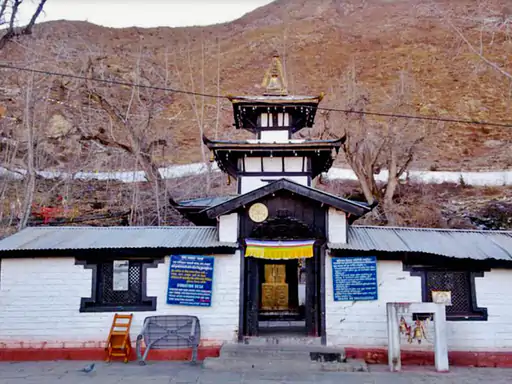
In the southern corner of the Muktinath area is a place called Mebar Lhakhang Gompa. This temple is also known as Salamebar Dolambar Gompa or Jwala Mai Temple. Fire continuously burns here, due to natural gas, so it is considered the place where Lord Brahma performed his Yajna. Along with this fire, water also flows, making it an extremely rare combination of water and fire. Hence, this place is regarded as a symbol of the trinity and the five elements. As per the mythological tales, Lord Vishnu killed the demon Jalandhar, breaking the fidelity of his wife Vrinda. Vrinda cursed Lord Vishnu, turning him into a worm. Thereafter, Lord Vishnu resided in the form of the Shaligram rock, and was liberated from the curse. Hence, it is also known as the Muktinath Dham. Since there is a monastery here, it is an essential pilgrimage site for the followers of the Buddhist religion as well.
In addition to the Shaligram rock, there is another Hindu temple in the Muktinath region, named the Shiva Temple. It is surrounded by four small temples, showcasing idols of Lord Shiva and Goddess Parvati. In contrast, there is also the temple of Lord Vishnu, who is regarded as the protector of the southern universe. At the back of the Shiva temple is the temple of Lord Rama, the seventh incarnation of Lord Vishnu. Next to it is the temple of Lord Krishna, considered to be the eighth incarnation of Lord Vishnu. Lastly, there is the temple of Lord Ganesha, who is the son of Lord Shiva and Goddess Parvati, and also the deity of knowledge. The confluence of the Gandaki and Damodar Kund rivers near the Muktinath Dham is called Kakbhusundi. According to belief, performing a Shraddha here liberates 21 generations. The Srimad Bhagavat Purana depicts the story of Dhumketu who performed Shraddha here, freeing 21 generations from sin and leading them towards salvation.